DXP vs CMS: which platform actually drives B2B sales growth?
B2B sales growth is no longer driven by a good product or website alone, but by how well a company ties content, customer data, pricing and self-service into one experience. When a CMS supports growth and when a DXP or composable experience stack drives it — a B2B view, with signals from Gartner, Forrester and IBM.
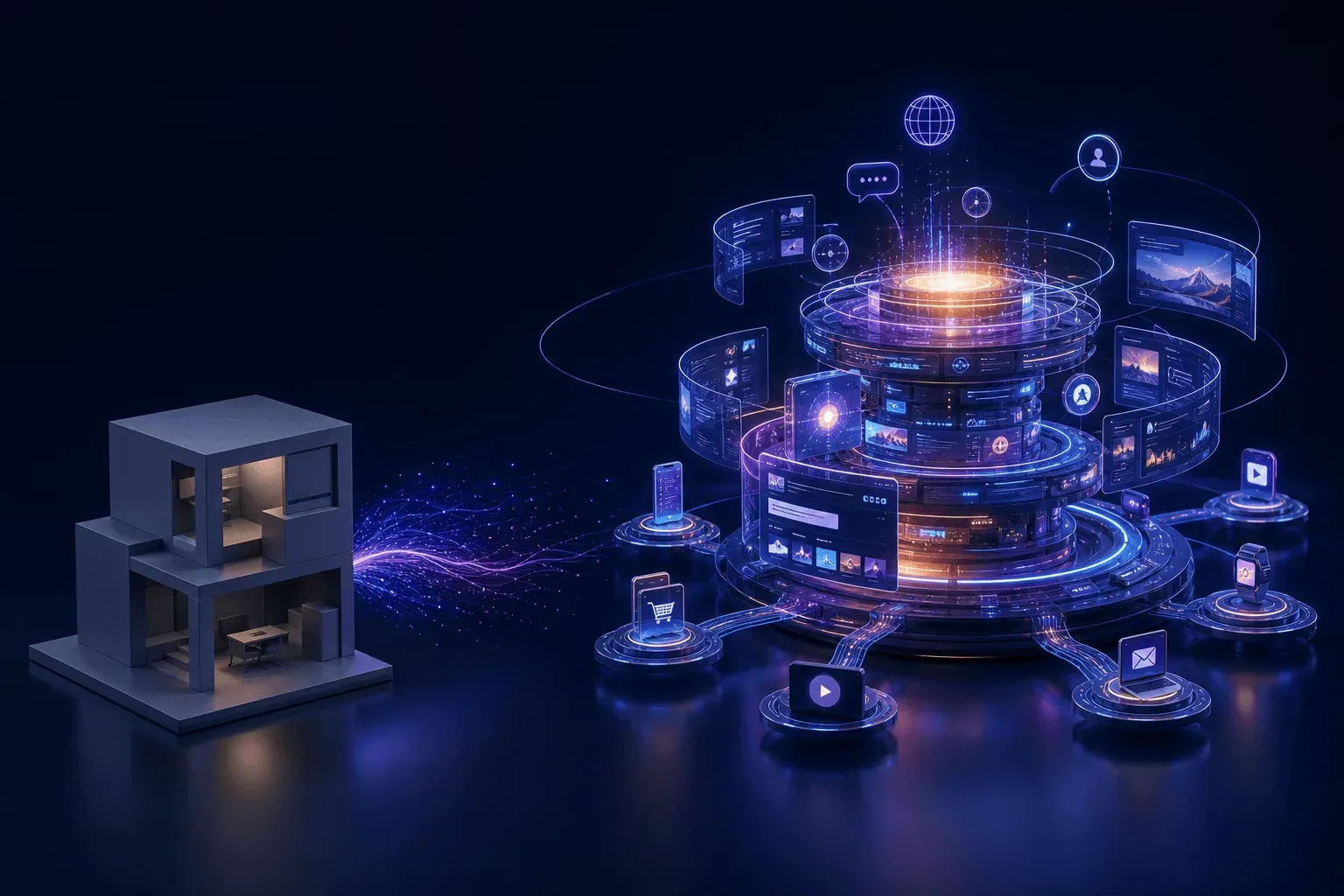
For some time now, B2B sales growth has no longer been driven by a good product, a strong sales team or a decent website alone. An ever-larger share of growth comes from how well a company can tie content, customer data, pricing, product availability, self-service and the buying journey into a single whole. This is exactly where the line runs between a classic CMS and a DXP. Where a CMS is built to manage content, a DXP or composable experience stack is built to orchestrate experience. In a B2B context, that difference is directly tied to whether the digital channel supports sales growth or drives it.
Why a CMS alone may no longer be enough
A content management system solves one very important problem well: how to create, manage, translate, version and publish content on the web. This is necessary for every company with multiple audiences, multiple markets or a more complex content model. But from a B2B sales perspective, content alone is not enough. The buyer is not looking only for blog text or a product image. They expect the digital channel to reflect their account status, contract price, product availability, order history, user roles, quote logic and the company's internal processes.
This is where the CMS hits its limit. A CMS can display this information, but it is generally not a system whose central purpose is to orchestrate experience across different data layers. When the platform has to tie ERP, CRM, PIM, commerce, analytics and account permissions into one seamless experience, the CMS usually remains a supporting layer rather than the primary growth engine.
The role of a DXP in B2B growth
A DXP, or Digital Experience Platform, is built to solve a different question. The question is not only how to manage content, but how to design, deliver and optimise experience across all digital touchpoints. Gartner's and Forrester's analyses describe a DXP as experience infrastructure that connects content, data, personalisation, integrations and orchestration. IBM's digital-experience framework moves in the same direction: digital experience is not a single web page, but a network of interactions between customer and company.
In B2B this is especially important. Sales growth is determined not only by whether the page carries the right message, but by whether the customer can immediately see a product range relevant to them, the prices that apply to their company, delivery information, order for themselves, request a quote, track order status and, when needed, move smoothly on to sales or service. Where a CMS provides content, a DXP provides an orchestrated experience that can directly shorten the sales cycle and raise the level of customer self-service.
The Gartner view: why composable becomes the standard
In a 2026 context, you cannot talk about DXP without composable architecture. The analytical commentary around Gartner's DXP Magic Quadrant strongly indicates that the market is moving from monolithic DXP suites toward a composable approach. This means companies no longer want to buy one large closed platform; they prefer to assemble the best possible experience stack from different components: CMS, commerce engine, PIM, CDP, search, analytics, DAM, personalisation and an integration layer.
This shift is logical from a B2B perspective. B2B sales already require strong coupling of back-end systems. So growth is not necessarily driven by a "big DXP" as a single product, but rather by how well a company can build a DXP-like orchestration layer around its existing systems. In such a model a CMS can remain a very important component, but it is no longer the centre of the whole architecture.
The Forrester shift: experience is no longer consumed by humans alone
Forrester's Digital Experience Platforms Wave shows that the DXP category is moving increasingly toward agentic orchestration. This means that in the future, experience will not be consumed only by a human user in a web browser. It will also be consumed by assistants, automated workflows, AI agents and different kinds of digital interfaces. This makes the idea of a DXP even more important, because the platform has to be able to drive experience dynamically, not just display static content.
In a B2B environment, the impact of this is very practical. When part of the buying process moves into self-service, automated quote generation, agent-assisted recommendations or account-based workflows, the experience platform has to operate far more broadly than a classic web-content system. In that sense, a DXP is naturally better aligned with the future of B2B sales than a pure CMS.
Where sales growth actually comes from
The main question is not whether a company has a CMS or a DXP. The main question is where sales growth actually comes from. If growth comes primarily from content marketing, SEO, brand visibility and simple lead generation, a good CMS with a strong integration layer can be entirely sufficient. But if growth comes from the digital channel replacing part of the sales team's work, giving the customer an account- and contract-based experience, enabling self-service and tying sales and service logic into one whole, then value clearly shifts toward a DXP or composable experience stack.
In other words: a CMS supports sales growth when content is the main amplifier. A DXP drives sales growth when the experience itself is the main amplifier.
The hub vs. spoke framework
To understand this difference better, it helps to use the hub vs. spoke mindset. If the web or portal is a spoke, it means it is one channel in a larger ecosystem. It shares content, supports campaigns and routes the user onward, but does not carry the management of the whole experience. In that situation a CMS fits well. But if the platform is a hub, it means it is the central gateway to sales, self-service, service, partners or customer interaction more broadly. There, content alone is no longer enough; experience management is required.
B2B companies are increasingly moving toward exactly this hub model. Their customers want to search, compare, order, track, manage users, view prices, check availability and resolve questions themselves — without every step requiring a sales rep's intervention. Such a platform is no longer merely a website. It is a digital sales channel that needs DXP-like capability.
So must a B2B company always choose a DXP?
No. That would be too simple a conclusion. For some companies, a strong enterprise CMS with very good integrations is entirely sufficient — especially when the digital channel's role is supporting, the number of channels is limited and the personalisation need is moderate. Not every company needs a full-scale experience platform.
It is wrong, however, to think that CMS and DXP are simply two "similar content platforms". When an organisation needs to combine experience, data and business logic for the sake of sales growth, the DXP category — or at least a composable experience stack — is the strategically more correct framework. In other words: the question is not always whether to buy a ready-made DXP, but whether the company's architecture must behave like one.
The strategic answer to the headline question
If the headline asks which platform actually drives B2B sales growth, the most precise answer is this: growth is driven neither by a CMS alone nor by a DXP as a label. It is driven by the platform that can orchestrate content, customer data, pricing, product information, account permissions, self-service and the buying journey into a single digital experience.
In practice, this means a classic CMS is usually necessary but rarely sufficient. B2B sales growth is more often driven by a DXP or composable experience stack, where the CMS is an important part but neither the only nor the central logic layer. Where the digital channel has to genuinely sell, not just inform, the centre of gravity shifts from content management to experience orchestration.
References
Gartner / Contentstack. Gartner® Magic Quadrant™ for Digital Experience Platforms. contentstack.com
MACH Alliance. Composable comes of age in the Gartner DXP Magic Quadrant. machalliance.org
Mark Demeny. Some Thoughts on the Gartner Digital Experience Platforms (DXP) Magic Quadrant for 2025. markdemeny.com
Forrester. Announcing The Forrester Wave™: Digital Experience Platforms, Q4 2025. forrester.com
IBM. What Is Digital Experience? ibm.com
Zaproo. DXP vs CMS: Strategic Guide 2026. zaproo.com



One letter a month.
Engineering notes only.
Subscribe coming soon.