E-commerce development in Estonia: how local competence reaches international level
E-commerce development in Estonia is no longer a website project but the binding of technology, customer experience, integrations and growth logic into one system. Why a local team’s level is measured by international commerce principles: process maturity, architecture, performance and maintainability. Based on McKinsey, IBM and Adobe guidance.
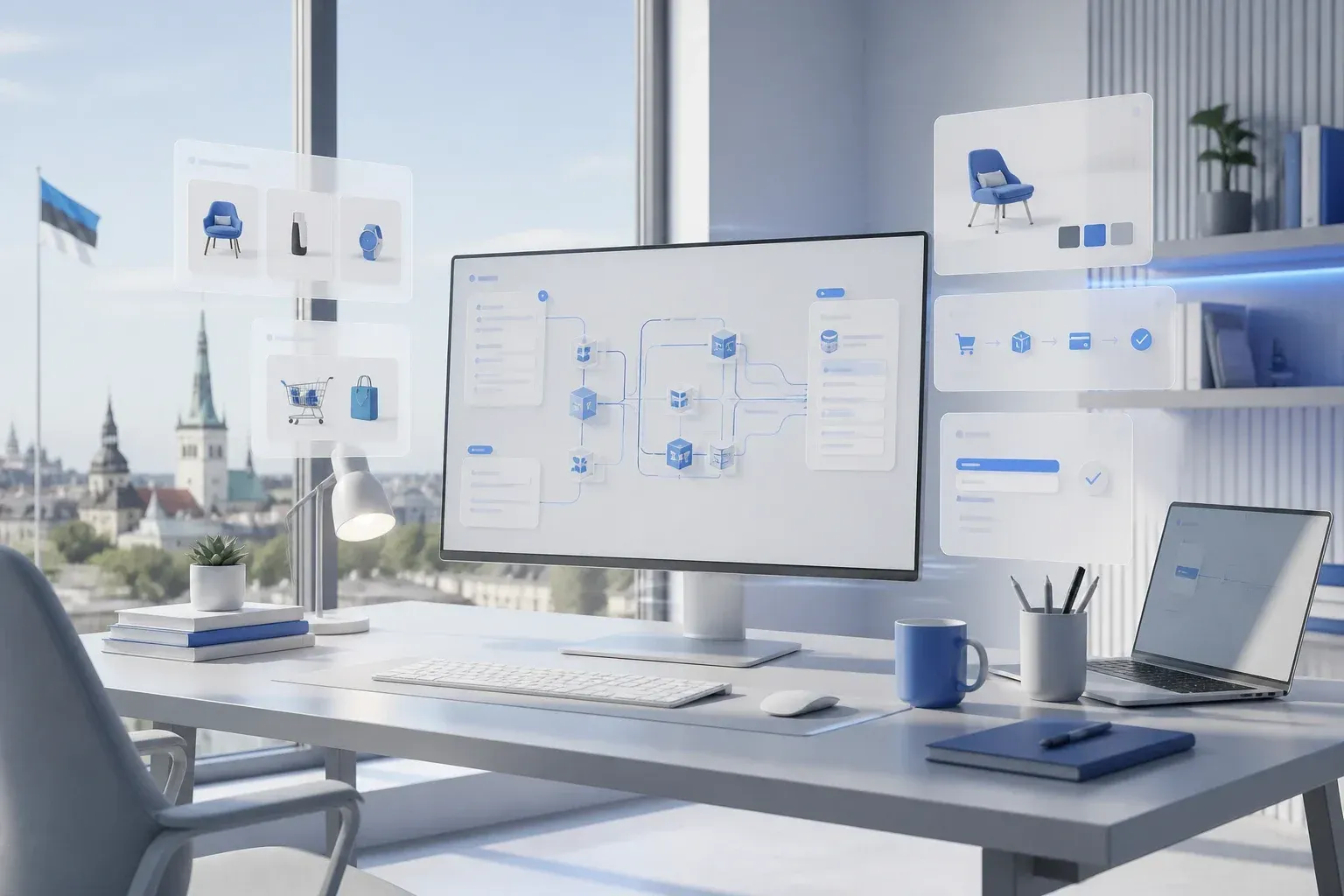
According to McKinsey, e-commerce is no longer a company's side channel but a core capability whose quality directly affects growth, loyalty and competitiveness. This means e-commerce development is no longer about ordering a website, but about making a strategic decision on how digital sales function in the business.
This is especially relevant in Estonia. A small market, high digital maturity and strong technical competence create a situation where local development teams must think internationally even when a project starts from a local need. E-commerce development in Estonia reaches international level when it follows the same principles described by the world's strongest commerce analyses: a clear customer journey, scalable architecture, manageable integrations and continuous developability.
E-commerce development is no longer a website project
McKinsey stresses that for companies coming from the offline world, adding e-commerce is difficult precisely because it requires rethinking business processes, channels and technology. A store is not an isolated website, but a digital hub of business operations that must connect product information, inventory, payments, logistics, customer communication and analytics into one functioning whole.
When a store is built only for the moment of launch, not for long-term development, costs accumulate later: slow changes, difficult integrations, weak performance and complex maintenance. Strong e-commerce development is therefore essentially an architecture decision, not just an order for design or code.
Which platform for which business
The first question in e-commerce development is often which platform to choose. This question is important, but insufficient on its own. McKinsey and IBM analyses show that growth does not depend only on the platform name, but on how the company connects technology to the customer journey and internal work logic. Still, the platform choice helps define what is possible and what is not.
Shopify is a cloud-based platform where a store can be launched quickly and with a smaller budget (5,000 to 15,000 euros for setup and design). It suits small and medium retailers whose primary need is a fast start and simple management. Limitations appear when business logic becomes more complex: custom B2B flows, specific integrations or full control over code are not natural in Shopify.
WooCommerce (WordPress plugin) is the cheapest entry point (3,000 to 10,000 euros for setup), but suits mainly small stores. WooCommerce is not a scalable e-commerce platform, but a website extension whose performance and security depend on many third-party plugins. At medium and larger volumes, maintenance becomes complex.
Magento 2 (Adobe Commerce / Open Source) is an enterprise-class platform that gives full control over code, data and integrations. The cost is higher (30,000 to 80,000 euros for the initial build), but in return you get a scalable architecture, strong B2B capability and an integration layer that Shopify and WooCommerce do not offer. Magento 2 suits companies that already have information systems (ERP, PIM, CRM) and need a store that works with them as a whole.
Headless architecture (e.g. Magento 2 backend + Nuxt 3 storefront) separates the user interface from the backend, giving maximum performance and design freedom. The cost is highest (50,000 to 150,000 euros), but the result is faster, more flexible and more future-proof to update. Headless suits companies for whom speed, conversion and technical independence are strategic goals.
Medusa.js is an open-source headless platform built on Node.js that gives full control over code and architecture. The cost is moderate (40,000 to 100,000 euros for the initial build), and it suits developer-led teams and startups that want to build a store from scratch without the weight of a large platform. Medusa.js has a smaller ecosystem than Magento 2 and fewer ready-made integrations, but for technically strong teams this is an advantage, not a limitation: the codebase stays clean and every decision is yours.
Integrations decide whether the store scales
IBM's digital experience view stresses that digital experience arises from the interplay of many systems and channels. In e-commerce, this means the store must work together with warehouse management, ERP, payments, delivery, campaigns, product information and analytics. When one of these layers is weak or isolated, the whole experience starts to falter.
In practice, this means the following integrations must be planned during e-commerce development:
ERP and financial software (e.g. SAP, Microsoft Dynamics): product synchronisation, order forwarding, inventory updates, invoice generation
Payment solutions (e.g. bank links, card payments, purchase protection): secure and fast checkout, payment method availability logic
Logistics and shipping (e.g. parcel lockers, courier, international delivery): delivery options, shipment tracking, returns management
CRM and marketing (e.g. Custobar, Mailchimp, HubSpot): customer segmentation, personalised offers, buyer behaviour analysis
Analytics and data processing (e.g. Google Analytics 4, GTM, conversion tracking): purchase journey measurement, A/B tests, growth indicators
Adobe Commerce's official guidance specifies that the maintainability of large commerce projects depends on regular updating, pre-testing, extension control and a structured release process. This principle applies more broadly than just Adobe Commerce. A store developed in Estonia reaches international level when integrations are not built ad hoc and maintenance is not based only on a "fix it when something breaks" approach.
Customer experience is the central measure of development
McKinsey's customer experience view stresses that strong companies start by improving the most important customer journey and tie it to measurable business results. IBM adds that trust, relevance and convenience are the three pillars of an excellent shopping experience.
A good store is intuitive, fast and trustworthy for the customer. It helps find the right product, displays key information clearly, keeps checkout simple and makes the whole experience consistent across devices and touchpoints. When a development team can think not just "what to build", but "what customer behaviour to support", it is essentially already an international-level commerce partner.
How to evaluate an e-commerce development partner: six questions
Choosing an e-commerce development partner is at least as important as choosing a platform. The following six questions help assess whether a partner thinks about the project or only about the code:
How do you approach integrations? Are integrations part of the architecture or added later ad hoc? A strong partner describes the integration layer already in the proposal phase.
What happens a year after launch? Does the partner have a maintenance and development model after project handover? Are updates, security patches and performance monitoring part of the service?
How do you ensure performance? Does the partner talk about Core Web Vitals, caching strategy, image optimisation and CDN configuration? These are not add-ons, but fundamentals.
Do you have experience with B2B flows? If your business needs credit systems, company management, recurring orders or custom price groups, the partner must know this before the project starts.
How do you manage technical debt? Does the partner talk openly about what happens when a quick solution becomes an obstacle? Do they have a migration strategy and an update plan?
Do you understand our business, not just our code? Does the partner ask about sales logic, customer journey and growth plans, or focus only on a feature list?
Five common mistakes that cost more later
Choosing a platform by price alone. The cheapest platform becomes more expensive when integrations, performance and maintenance add up. TCO (total cost of ownership) is what matters, not the initial build cost.
Postponing integrations. "We will do integrations later" is the most common reason a store does not scale. Integrations must be part of the architecture, not an afterthought.
Ordering design without considering technology. A beautiful design that does not account for platform constraints, performance requirements or integration needs becomes more expensive and slower in development.
Leaving maintenance unplanned. A store needs regular updates, security patches, performance monitoring and content management. When maintenance is not a budgeted ongoing activity, the system becomes slow and security-risky within a year.
Unclear ownership. Code, design and data must belong to the client. If the partner keeps the code or the platform does not allow data export, a dependency is created that limits future choices.
Conclusion
E-commerce development in Estonia is today a mature field, but its real level does not depend only on technical execution skill. The level depends on whether the development partner can tie customer experience, business processes, integrations, performance and continuous maintenance into one systematic capability. It is precisely in this sense that local competence reaches international level: not because the market is small and clever, but because strong players solve the same commerce problems on the same mature principles as the world's best teams.
References
McKinsey & Company. What is e-commerce? mckinsey.com
McKinsey & Company. Power forward: Five make-or-break truths about next-gen e-commerce. mckinsey.com
McKinsey & Company. NeXT Commerce: the future of e-commerce. mckinsey.com
IBM. How to Build a Successful Ecommerce Strategy. ibm.com
IBM. What Is Digital Experience? ibm.com
Adobe Experience League. Best Practices | Adobe Commerce. experienceleague.adobe.com
Elsner. Proven Tips to Boost Adobe Commerce Store Performance. elsner.com