The Autonomy Era: Why the Orchestration Gap Is the Real B2B Bottleneck
Most B2B companies don't lack systems: they lack coordination between them. Why the orchestration gap, not missing tools, is the real operational bottleneck in the autonomy era, and how an orchestration layer turns connected systems into autonomous operations. Based on IBM, McKinsey, Forrester and Gartner.
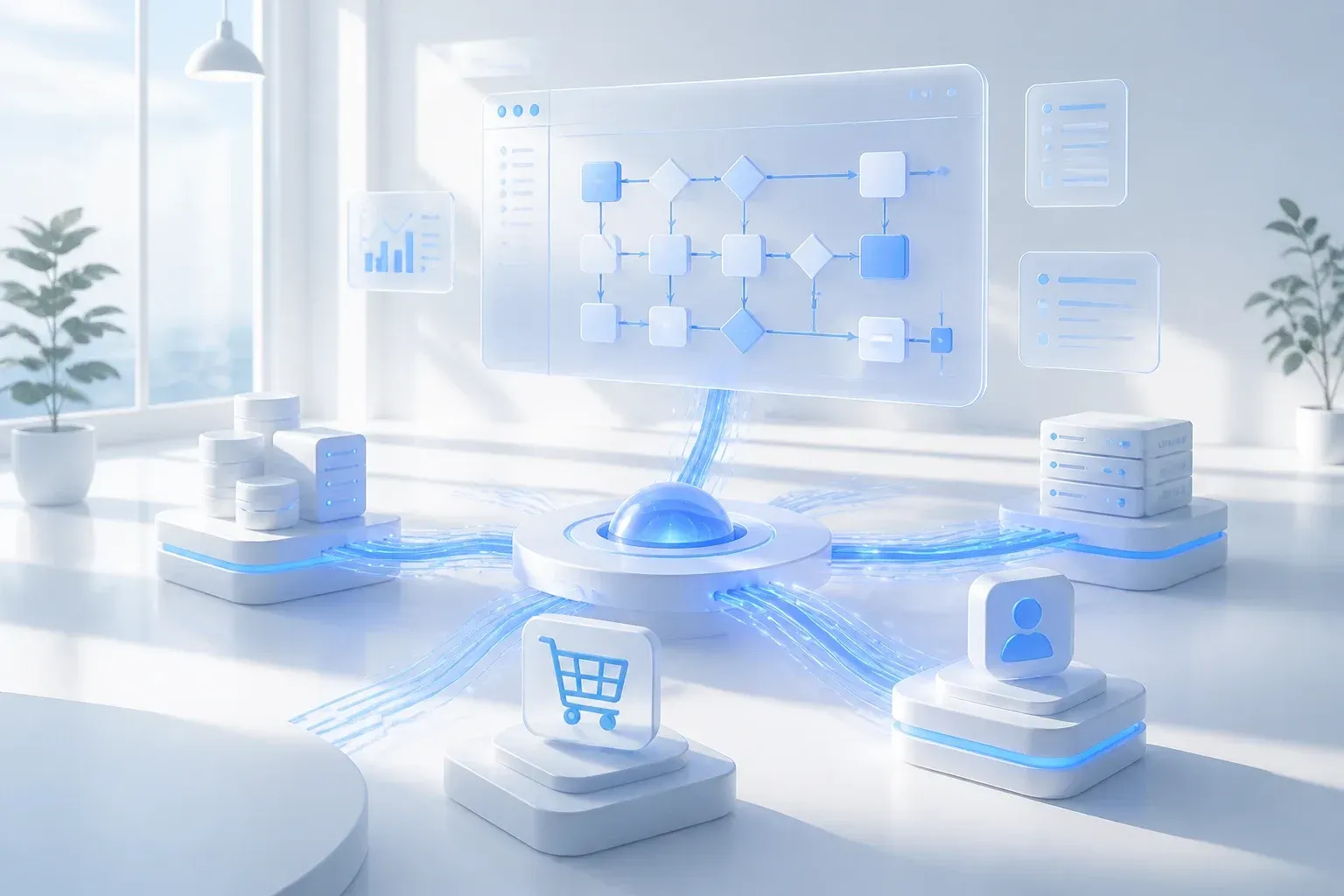
Most B2B companies no longer suffer from a lack of systems. They suffer from a lack of coordination between them. ERP, ecommerce, CRM, customer service, logistics, pricing and data tools may all be present, integrated and technically operational, yet the business still relies on people to monitor exceptions, reconcile information and push work across departmental boundaries. That gap between connected systems and coordinated outcomes is where the real operational drag now lives.
This is why the idea of the orchestration gap matters. In the autonomy era, the competitive question is no longer whether a company has digital tools, APIs or automation scripts. The harder and more consequential question is whether those systems can sense events, apply business logic, trigger decisions and move work forward without waiting for manual intervention. When that capability is missing, companies accumulate what looks like digital maturity on the surface but still carry a heavy manual operating model underneath.
Integration is no longer enough
Traditional integration solved an important first problem: it allowed systems to exchange data. But data exchange alone does not create business autonomy. IBM defines workflow orchestration as the coordination of multiple automated tasks across business applications and services so execution remains seamless across the whole process, not just within one isolated task. That distinction is critical. An integrated environment may move order data from a storefront to an ERP, but it does not necessarily decide what happens when inventory is wrong, pricing conflicts appear, payment anomalies surface or fulfillment conditions change.
McKinsey's work on agentic AI points in the same direction. Agents are valuable precisely because they can support workflows across multiple systems rather than remain hardwired inside one platform. In other words, the business value no longer sits inside individual applications alone. It sits in the coordination layer between them. If that layer is weak, even a modern stack becomes operationally brittle.
The hidden cost of the orchestration gap
The orchestration gap rarely appears as one obvious failure. It appears as friction spread across dozens of ordinary steps. Someone checks whether the price shown to the customer matches the contract price. Someone else resolves an out-of-stock exception. Another person updates a shipping status manually because one system did not trigger the next action. Customer service spends time explaining delays that should have been predicted and communicated automatically.
IBM's broader orchestration research frames the issue well: the problem is often not a lack of data, but the absence of real-time orchestration that can turn data into decisions and delivery. Without that layer, businesses keep adding tools while still losing time, consistency and responsiveness. CIO-level analysis of agentic AI orchestration makes the same point from another angle: without a coherent orchestration strategy, companies may gain local workflow efficiencies but miss the larger opportunity for strategic transformation.
This is the real operating tax of the autonomy era. It is not just manual work in the abstract. It is delayed decisions, fragmented accountability, slower response times, inconsistent customer communication and a scaling model that depends too heavily on adding more people to manage exceptions.
Why B2B feels this pain more sharply
B2B commerce amplifies orchestration problems because the workflows are inherently more conditional and multi-system. Pricing may depend on contracts, account hierarchies, segment rules or negotiated terms. Orders may require approval logic, stock checks, fulfillment routing or credit evaluation. The customer journey may move between self-service, sales-assisted and service-assisted interactions before one purchase is complete.
That matters because buyer expectations have shifted. McKinsey's B2B Pulse findings show that buyers are increasingly comfortable spending through remote and self-service channels, while Forrester notes that digital buying and self-service now appear across all buying stages. This creates a hard requirement inside the business: if external buying becomes more autonomous, internal operations must become more orchestrated. Otherwise the customer experiences a digital front end sitting on top of a manual back office.
Orchestration is the bridge to autonomy
The path from fragmented operations to autonomy is not more AI in the abstract. It is better orchestration. IBM describes agentic workflows as AI-driven processes where autonomous agents make decisions, take actions and coordinate tasks with minimal human intervention. That definition is useful because it shifts focus away from isolated models and toward goal-driven execution across systems.
In practical terms, orchestration means building a layer that can listen to events, evaluate business rules, invoke the right tools and determine whether the next step should be automated, routed to a human or escalated. An order delay does not just update a field. It triggers a customer notification, a fulfillment check, an internal priority change or an alternative sourcing decision. A pricing conflict does not sit in a queue waiting for someone to notice it. It becomes a governed workflow.
This is also where Zaproo's perspective becomes relevant. The challenge is not only building integrations, but turning them into an operational nervous system for B2B commerce. The orchestration layer is what closes the distance between technical connectivity and business autonomy.
What an orchestration-native B2B model looks like
An orchestration-native model treats automation, decisioning and exception handling as one coordinated system rather than separate projects. It assumes that value comes from how systems work together in motion, not from how impressive each one looks in isolation. The goal is not to eliminate people from the process. The goal is to remove low-value coordination work so people can focus on approvals, relationships, edge cases and higher-order judgment.
This kind of model usually has several traits:
Event-driven workflows rather than batch-driven reactions.
Shared business rules across systems instead of hidden logic inside spreadsheets or tribal knowledge.
Clear governance over what agents can do autonomously and what requires human approval.
End-to-end observability so exceptions, delays and anomalies are visible before they become customer-facing problems.
A composable architecture where workflows can evolve without forcing a full replatforming effort.
These patterns align with broader market signals as well. Gartner estimates cited in 2026 B2B commerce analysis suggest that composable architecture adoption is rising sharply and that autonomous shopping assistants will manage a growing share of B2B procurement in the coming years. Whether a company adopts those exact tools now or later, the architectural implication is already clear: autonomy depends on orchestration.
Where companies should start
The first step is not buying a new orchestration product. It is diagnosing where the orchestration gap already exists. That usually means identifying workflows where systems exchange data but decisions still depend on human coordination. Order exceptions, contract pricing, inventory mismatches, customer status communications, fulfillment routing and account-level approval chains are common starting points.
From there, the work becomes more strategic than technical. Companies need to decide which workflows should become autonomous first, which ones require human-in-the-loop controls and which business rules need to be standardized before agents or orchestration engines can act safely. McKinsey's agentic AI guidance, IBM's workflow orchestration framework and current enterprise discussions around orchestration architecture all converge on the same conclusion: real value comes from redesigning end-to-end workflows, not just automating isolated tasks.
The strategic implication
The orchestration gap is not a minor process issue. It is becoming one of the main reasons B2B companies struggle to scale digital operations profitably. A business can have strong platforms, rich data and modern interfaces and still remain operationally slow if coordination sits with people instead of systems.
That is why the autonomy era changes the strategic agenda. The next wave of advantage will not come from adding more disconnected tools or experimenting with agents in isolation. It will come from building the orchestration layer that turns systems, signals and decisions into coordinated action. For B2B companies, this is the shift from being digitally connected to being operationally autonomous.
References
IBM. What is Workflow Orchestration? ibm.com
IBM. What are Agentic Workflows? ibm.com
McKinsey & Company. Seizing the agentic AI advantage. mckinsey.com
IBM Newsroom. IBM Introduces Industry Solutions for AI-Powered Experience Orchestration with Adobe. newsroom.ibm.com
CIO. IBM delivers agentic AI orchestration to drive a productivity edge. cio.com
CIO. Beyond the agent: redefining workflows for the autonomous enterprise. cio.com
McKinsey & Company. B2B Pulse: Five fundamental truths about how B2B winners keep growing. mckinsey.com.br
Forrester. Self-Service Buying Is A Wake-Up Call For B2B Sales. forrester.com
Creatuity. AI in B2B Commerce: 55 Statistics You Need to Know in 2026. creatuity.com