Incomplete orders vs. abandoned carts: an ROI guide
"Abandoned cart" actually hides two different things: an abandoned cart (intent lost to checkout friction) and an incomplete order (the payment or checkout flow had already technically started). Why to separate them, how to draw the line in analytics, and which recovers more revenue: through the logic of Baymard, Forrester and Stripe.
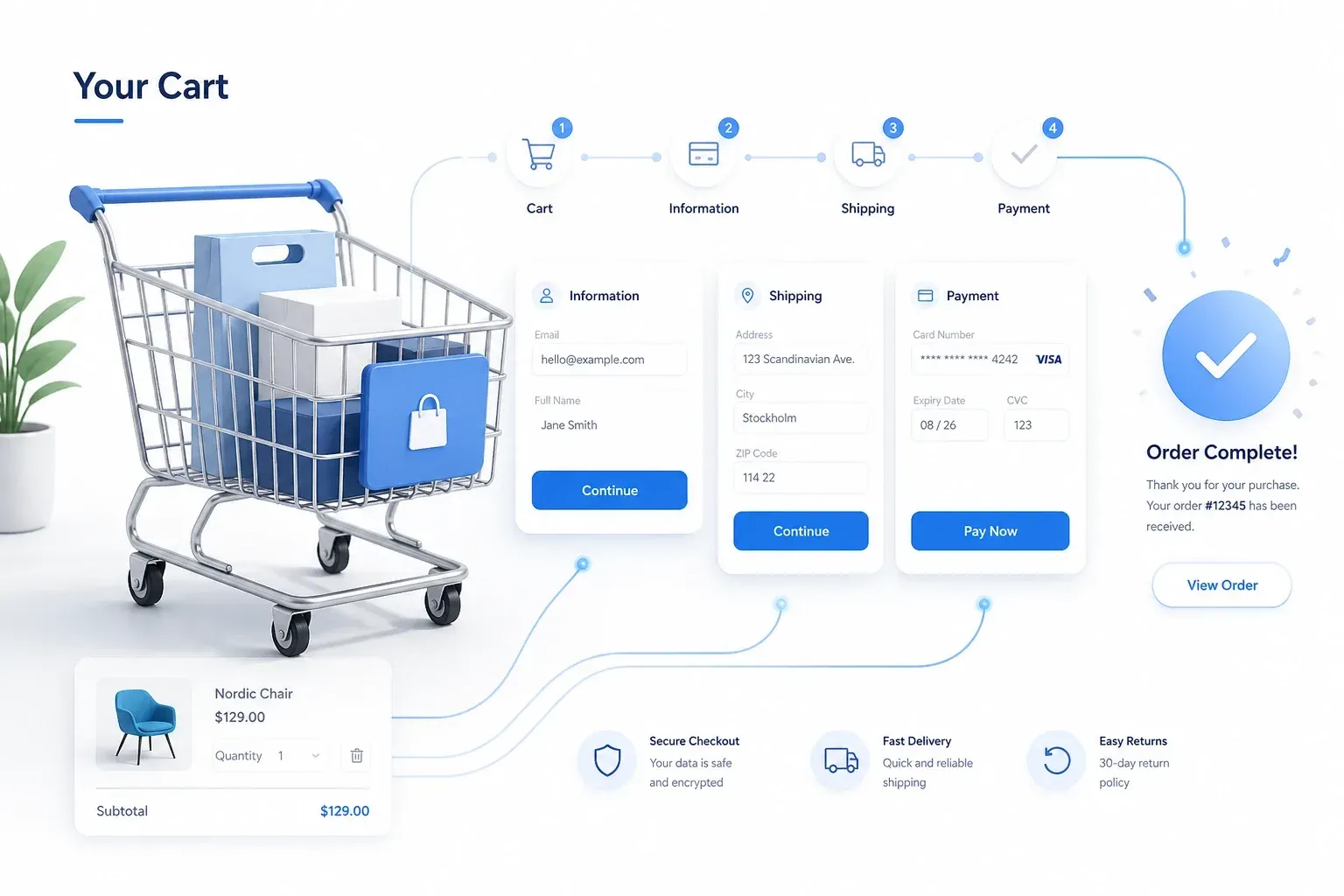
In e-commerce, a single umbrella term — the abandoned cart — is often used, even though in practice the drop-off can happen at different points along the buying journey. This matters, because not every drop-off means the same thing or needs the same recovery logic. When a company treats every unfinished purchase as one number, both the analytics and the revenue-recovery work become imprecise.
The most useful distinction is between an abandoned cart and an incomplete order. An abandoned cart describes a situation where the user adds a product to the cart but does not reach order confirmation. An incomplete order describes a situation where the checkout or payment flow has already technically started, but the transaction does not complete successfully. This very difference determines whether you are dealing with a user-experience, trust and purchase-readiness problem, or with a transaction left unfinished in the payment and checkout lifecycle.
What an abandoned cart is
According to Baymard's aggregated data, the average cart abandonment rate is 70.22 percent. This number shows how large a share of users add products to the cart but do not complete the purchase. Baymard's checkout research shows at the same time that this is not only a "lost interest" problem, but very often the result of friction in the checkout itself.
Specific causes recur in Baymard's data: extra costs that are too high, delivery that is too slow, forced account creation, a long or complex checkout, and insufficient trust at the moment of payment. Forrester's shopping cart abandonment analysis supports the same logic, emphasising that a retailer's ability to recover revenue depends heavily on how well it can remove obstacles from the buying path and make pricing and delivery clear before the final step of the purchase. An abandoned cart is therefore primarily a user-experience and process question.
What an incomplete order is
An incomplete order is not a classic marketing metric, but rather a technical and operational category. Stripe's Payment Intents documentation shows that the payment lifecycle can be tracked through different statuses. A PaymentIntent may require additional customer action, additional processing, or move on to a successfully completed status. Stripe recommends creating the PaymentIntent as soon as the customer's checkout has begun, to track the purchase funnel more precisely.
This means that when a payment or checkout object has already been created, but the transaction does not reach the succeeded status, the company has far more information than with an ordinary abandoned cart. The system may know whether the payment was left pending, whether customer action was required, whether authentication was interrupted, or whether the process needs new confirmation. It makes sense to treat such a situation as an incomplete order, because the buying journey had already reached the technical phase of the transaction.
Why the two must not be conflated
When all drop-offs are merged under a single abandonment metric, visibility into where the leak actually occurs is lost. One group of users leaves before checkout, because they are not yet confident enough, do not understand the price, or find the process too complex. The other group reaches a point where the purchase was essentially already underway, but a payment or checkout technical step was left unfinished.
These two situations need different remedies. For an abandoned cart, friction must be reduced: simplify checkout, show the total cost earlier, allow guest checkout and improve the mobile experience. For incomplete orders, you must instead track payment and order statuses, identify the point of interruption, and offer the customer a fast way to continue from the same place. If the two are treated identically, the recovery strategy becomes too generic and part of the recoverable revenue goes unused.
Why an incomplete order is a more valuable signal in ROI terms
An abandoned cart does indicate purchase interest, but that interest can vary in strength. The user may have added the product to the cart for comparison, to check the price, or for a later decision. An incomplete order, by contrast, usually means the user has reached close to the technical final phase of checkout. They have invested more time, moved closer to payment, and initiated a process the system can track in detail.
Stripe's PaymentIntent logic makes this segment especially valuable. When the system sees that a payment requires extra action or was left unfinished before a successful confirmation, recovery communication can be tied to a specific state. This is no longer a generic "you left something in your cart" reminder, but a more precise revenue-recovery workflow: continue the payment, complete authentication, try again, or carry on through the same checkout flow. The recoverability of such cases is often higher than with a typical abandoned cart, precisely because the intent was already stronger.
How to measure it correctly in analytics
The most practical solution is to measure the purchase funnel as at least four clear events: add-to-cart, checkout started, payment or order object created, and purchase completed. When these events are separated, it immediately becomes visible whether the problem arises before checkout, inside checkout, or in the final payment phase.
This distinction also enables meaningful segmentation. If the user added a product to the cart but did not start checkout, it is a classic abandoned cart. If checkout started but no payment object was created, it points to checkout friction. If a PaymentIntent or other order object was created but did not reach a successful status, it makes sense to treat it as an incomplete order. Only then can you speak of genuinely precise ROI management.
What recovery logic fits an abandoned cart
For an abandoned cart, recovery usually starts before follow-up communication. Baymard's research indicates that the highest-impact improvements come from simplifying checkout, showing extra costs earlier, enabling guest checkout and reducing the overall complexity of checkout. Forrester's analysis likewise stresses that cleaning up the buying path is as important as the follow-up contact itself.
Only once the process itself is clearer do abandoned cart reminders and remarketing start to work better. If the reason for leaving was systemic — for example a checkout that is too complex or an unexpected price add-on — no follow-up email recovers as effectively as fixing the process itself.
What recovery logic fits incomplete orders
For an incomplete order, communication must be far more precise. Stripe's documentation shows that the PaymentIntent status reveals whether a payment has completed successfully, needs additional intervention, or was left unfinished. This makes it possible to build precise workflows that react not simply to the existence of a cart, but to the specific payment state.
In practice, this means the customer can be guided back to the same payment step, asked to complete the required action, or helped to re-confirm an already-started transaction. Such a workflow differs from classic abandoned cart automation, because the goal is not to reawaken interest, but to carry an unfinished transaction through to completion.
Where to invest first
When resources are limited, the investment order should be chosen by the strength of intent. The first priority is to reduce checkout friction, because Baymard's research shows that the causes of drop-off are often tied precisely to process complexity, extra costs and a lack of trust. The second priority is to take control of incomplete orders, because they represent the revenue that was closest to being realised.
This means the smartest step is not always simply amplifying an abandoned cart campaign. Often the greater business impact comes from separating incomplete orders into their own category, tying payment statuses to analytics, and building precise recovery logic on top of them. That is usually where the recoverable revenue is "hottest".
Strategic conclusion
An abandoned cart and an incomplete order are not synonyms. An abandoned cart describes a drop-off that often points to checkout friction, opaque pricing or insufficient purchase confidence. An incomplete order describes a situation where the purchase process has already technically started but does not complete successfully.
Understanding this difference makes both measurement and recovery far more precise. For an abandoned cart, the first priority is to improve the user experience. For incomplete orders, you must manage the payment and checkout lifecycle. Stores that distinguish these two phenomena get a far more accurate picture of where money is actually lost, and can recover more revenue where the transaction had already almost happened.
References
Baymard Institute. 50 Cart Abandonment Rate Statistics 2026. baymard.com
Baymard Institute. E-Commerce Cart & Checkout Usability Research. baymard.com
Baymard Institute. Reasons for Cart Abandonment – Why 70% Do So. baymard.com
Forrester. Understanding Shopping Cart Abandonment. forrester.com
Stripe Documentation. Payment status updates. docs.stripe.com
Stripe Documentation. The Payment Intents API. docs.stripe.com