Headless Magento 2: The Architecture Behind High-Performance eCommerce
Introduction: Breaking the Monolithic Ceiling
In the modern eCommerce landscape, traditional "monolithic" architecture—where the frontend and backend are tightly coupled—is increasingly becoming a bottleneck for growth. As customer expectations for sub-second speed and hyper-personalization skyrocket, ambitious retailers are moving toward Headless Magento 2. According to Gartner (Gartner, Inc.), the world's leading research and advisory firm, decoupling the presentation layer from the core business logic is the only way to achieve true Business Agility and long-term scalability in 2026.
At Zaproo, we view Headless Magento not as a technical trend, but as a fundamental business strategy to eliminate Legacy Debt and transform your store into a high-performance Efficiency Engine.
1. The Monolith Problem: Why Legacy Systems are Profit Anchors
Monolithic systems (like standard Magento, Shopify, or WordPress) manage everything in one place: the database, the business logic, and the HTML rendering. While this is simple to start, for an enterprise brand, it creates significant operational friction:
- Coupled Performance: A slow database query in the backend (e.g., during a massive B2B price calculation) directly slows down the customer’s page load.
- Development Rigidity: Any change to the UI requires a full-stack deployment, increasing the risk of downtime and slowing down your Time-to-Market.
- Limited Omnichannel Potential: Monoliths are designed for traditional browsers, making it difficult to serve the same high-fidelity data to mobile apps, smart devices, or IoT touchpoints without redundant custom coding.
2. Gartner’s MACH Principles and Composable Commerce
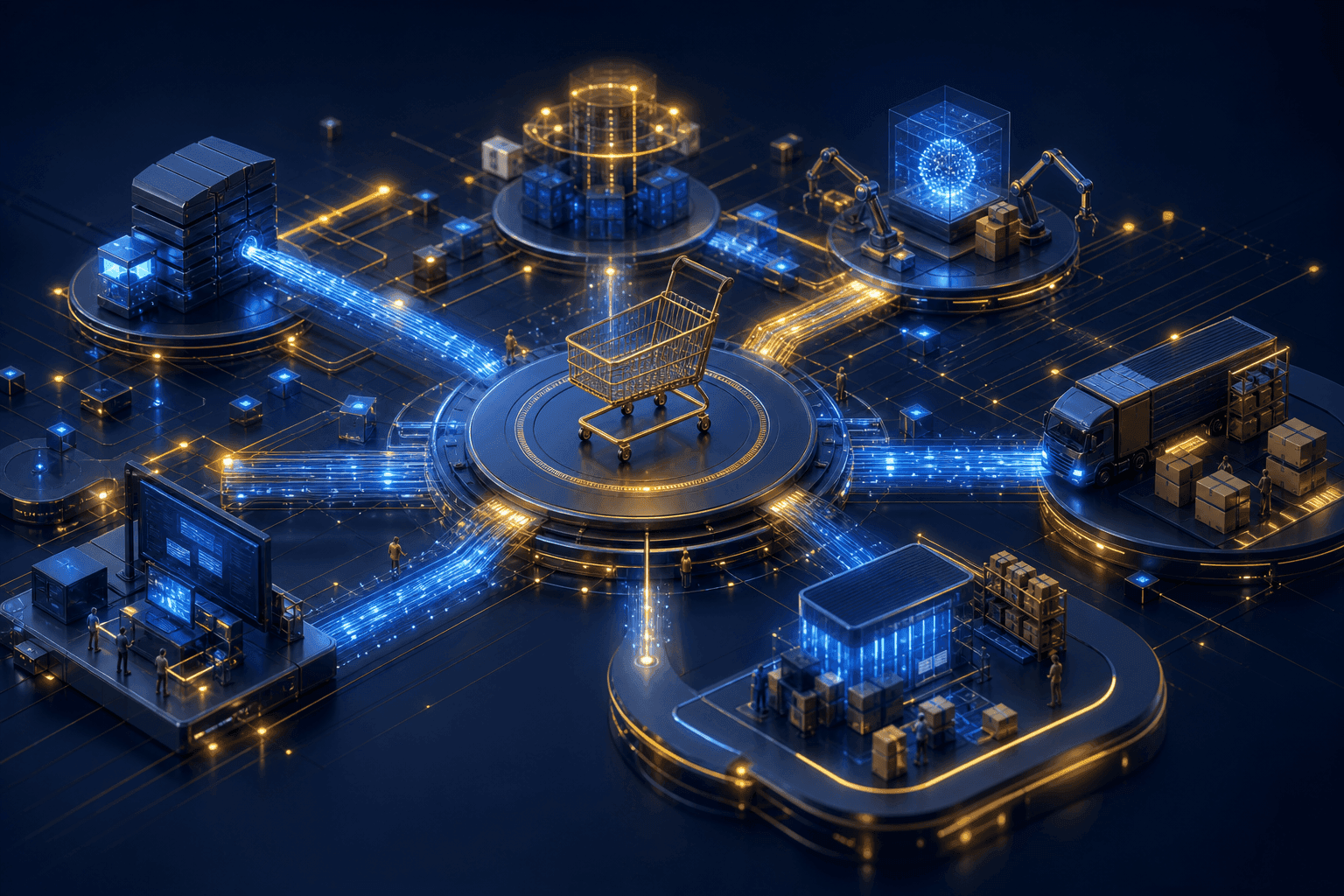
Gartner advocates for an architecture built on MACH principles: Microservices, API-first, Cloud-native, and Headless. Headless Magento 2 is the foundational layer of this vision. By decoupling the "head" (frontend) from the "body" (backend), you transition to Composable Commerce.
The Anatomy of a Headless Stack:
- The Core Engine (Magento 2): Handles the "heavy lifting"—order management, complex B2B pricing tiers, and transactional integrity.
- The Presentation Layer (Nuxt 4 / PWA): A fast, lightweight frontend that focuses exclusively on the user experience and SEO.
- The API Bridge (GraphQL): The "nervous system" that allows the two layers to communicate instantly and securely.
3. Technical ROI: Speed, Agility, and SEO Dominance
The return on investment for Headless is driven by measurable performance metrics that directly impact your bottom line.
A. Sub-Second Loading and Core Web Vitals
By utilizing SSR (Server-Side Rendering) and Edge Caching (like Varnish or Akamai), Headless storefronts achieve page transitions that feel instantaneous. Gartner’s research on Digital Friction indicates that every 100ms of latency reduction can increase conversion by up to 1%. This speed is the core of our site search best practices.
B. Marketing Independence and Content Governance
With a Headless setup, your marketing team is no longer dependent on the development sprint cycle. Using a headless CMS like Strapi 5, they can launch new landing pages, banners, and promo code campaigns in minutes. This agility reduces your operational OpEx and empowers the team to act on Big Data insights in real-time.
C. Superior Mobile Conversions
Traditional responsive sites often feel "clunky" on mobile. A Headless PWA (Progressive Web App) provides a native-app feel, allowing for offline browsing, push notifications, and ultra-smooth navigation. Given that over 70% of B2B research now happens on mobile, this is a mandatory requirement for scaling.
4. Technical Implementation: The Zaproo "Efficiency Engine" Way
Transitioning to headless requires a disciplined technical approach to ensure security and scalability.
- Native GraphQL Middleware: We eliminate the "overhead" of generic SDKs by building native GraphQL layers that fetch exactly the data required for each component.
- Event-Driven Integrations: Our eCommerce Integrations ensure that your ERP (Directo, NAV) and PIM (Akeneo) systems are synced via high-speed webhooks, not slow batch processes.
- Zaproo.Cloud Infrastructure: We host headless stacks in a managed Kubernetes environment optimized for SSR, ensuring 100% uptime and data sovereignty.
5. Conclusion: Future-Proofing Your Enterprise
Headless Magento 2 is not just a technical upgrade; it is a strategic repositioning. It allows you to build a Composable DXP (Digital Experience Platform) that can adapt as fast as the market does. By choosing a decoupled architecture, you are investing in a platform that will be as relevant in five years as it is today.
In 2026, the "Efficiency Engine" is the only sustainable competitive advantage. Are you building a future-proof engine, or just maintaining an anchor?
Ready to break free from monolithic limitations and skyrocket your performance? Contact Zaproo for a technical Headless migration roadmap.
Read more: