The Autonomy Era: Beyond Integration: The Orchestration Gap
Explore the Orchestration Gap and why mere integration is no longer enough. Learn how Zaproo.Flow and AI agents create autonomous business ecosystems.
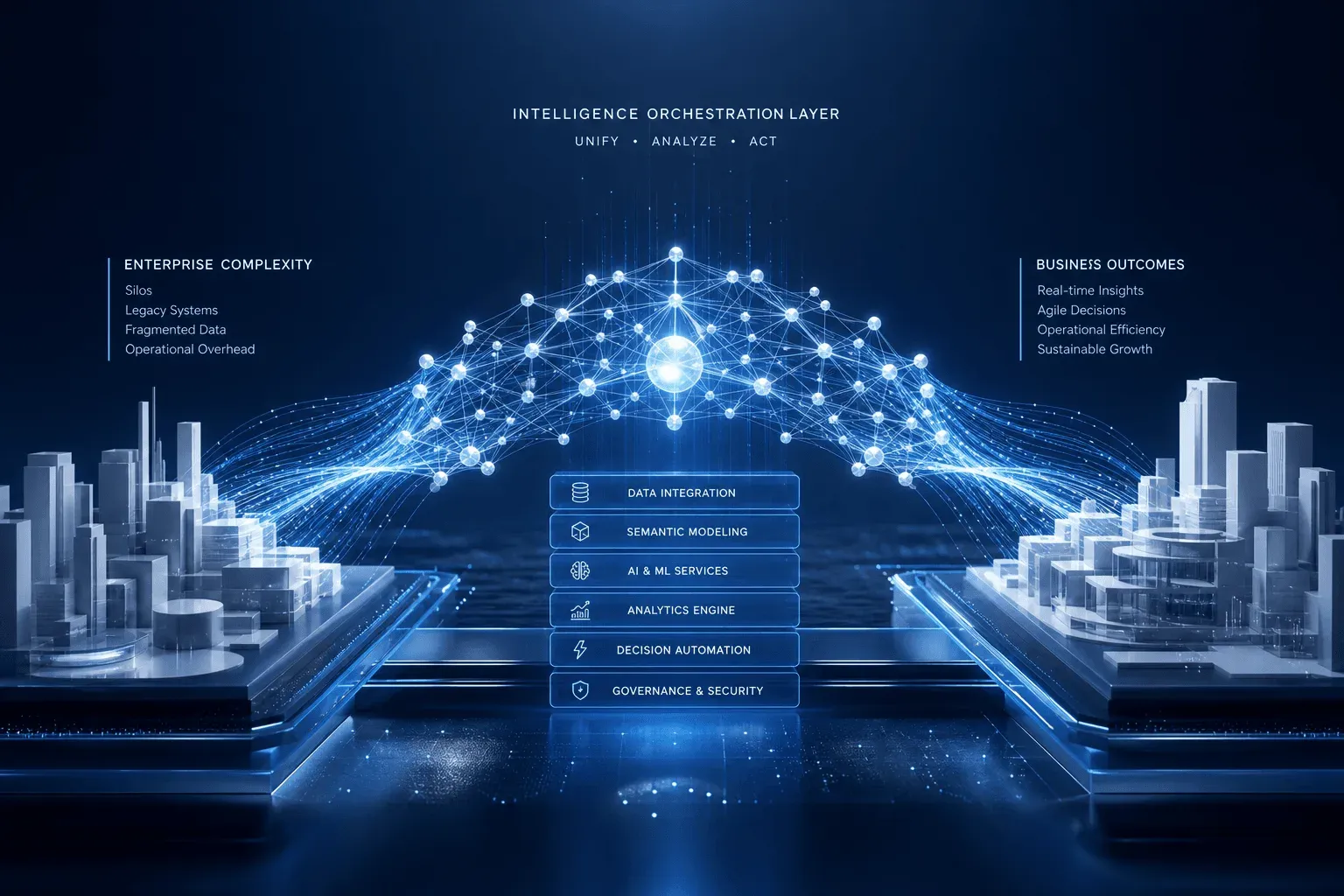
In the 2026 B2B landscape, mere integration is no longer a competitive edge—it is baseline hygiene. Connecting your storefront to an Enterprise ERP (such as Microsoft Dynamics 365 or SAP) merely keeps you in the race. The real efficiency breakthrough happens in the Intelligence Layer. This deep dive explores the Orchestration Gap: the measurable distance between having digital data and having an autonomous business process.
I. Defining the Orchestration Gap
Most organizations suffer from what we call the Orchestration Gap. While legacy businesses pay a "Manual Processing Tax" for human oversight of their integrated data, Autonomous Businesses use orchestration to bridge this gap. According to Gartner, "Intelligent Applications" and "Autonomous Business" are among the top strategic technology trends for 2026. This shift is driven by the need to move beyond "systems talking" to "systems deciding."
In a traditional setup, data flows between systems, but a human must still intervene to handle exceptions, validate complex pricing, or manage inventory anomalies. This human intervention is the gap where profitability is lost. If your integration requires a "coordinator" to ensure the data is correct, you are not orchestrated; you are merely connected. The Orchestration Gap is the silent friction that prevents a $100M company from becoming a $500M company without quintupling its headcount.
II. Beyond Point-to-Point Integration
Traditional point-to-point integrations are fragile. They move data but lack the "brain" to handle exceptions or predict stock needs in real-time. To fill the Orchestration Gap, businesses are adopting an Event-Driven Architecture (EDA). This architecture allows for a more dynamic and responsive system that can act on data as it happens, rather than waiting for a scheduled batch job.
1. The Role of the Orchestrator
An orchestration layer (utilizing tools like Zaproo.Flow) acts as the central nervous system of the enterprise. It doesn't just pass data; it evaluates it against business rules in real-time. For example, if an order is placed for an out-of-stock item, the orchestrator can automatically trigger a sourcing request from a secondary warehouse or notify the customer with an accurate lead time—without human intervention. This level of autonomy is what defines a modern, resilient B2B operation.
2. Cognitive Workflows and AI Agents
By adding an "Autonomous Factor" (AI Agents) to the orchestration layer, businesses can create cognitive workflows. These agents handle routine checks and anomaly detection that previously required manual oversight. Based on our experience across multiple Enterprise implementations, filling the Orchestration Gap can reduce manual data oversight by up to 70% (Zaproo internal benchmark). These agents are not just chatbots; they are production-ready logic units that maintain the integrity of your business processes 24/7.
III. The ROI of Autonomy: Economic Impact
The economic impact of bridging the Orchestration Gap is significant. By shifting from human-led to algorithmic decision-making, companies can eliminate the friction that typically erodes B2B profitability.
Key Advantages:
Self-Healing Workflows: The system automatically detects and corrects data discrepancies between the storefront and the ERP, ensuring that your "Single Source of Truth" remains accurate.
Dynamic Scalability: The orchestration layer handles increased transaction volumes without requiring a proportional increase in headcount. You can scale your revenue without scaling your administrative overhead.
Transactional Integrity: Ensuring that every order is validated against real-time business logic, even when backend systems are under heavy load or offline for maintenance.
|
Feature |
Legacy Integration |
Autonomous Orchestration |
|---|---|---|
|
Logic |
Static / Hardcoded |
Dynamic / Cognitive |
|
Error Handling |
Manual intervention |
Self-healing workflows |
|
Decision Making |
Human-led |
Algorithmic / AI-assisted |
|
Scalability |
Linear |
Exponential |
|
Response Time |
Batch / Delayed |
Real-time / Event-driven |
IV. Conclusion: Engineering the Intelligent Enterprise
The Orchestration Gap is the primary inhibitor of B2B growth in 2026. By moving beyond simple connectivity toward an intelligent, autonomous foundation, businesses can finally achieve the operational efficiency that digital transformation promised but rarely delivered. It is time to stop managing data and start orchestrating outcomes. The future of B2B is not just integrated; it is intelligent, autonomous, and engineered for certainty.
References & Bibliography
[1] Zaproo Internal Benchmark. Based on 20+ Enterprise ERP implementations and the transition to autonomous orchestration. [2] Gartner (2025). Top Strategic Technology Trends for 2026: Intelligent Applications. [3] McKinsey & Company (2023). The Price of Technical Debt. (Analysis of how legacy integrations hinder operational scalability). [4] Google and Deloitte (2020). Milliseconds Make Millions. (The correlation between technical performance and conversion integrity). [5] MACH Alliance. The Case for Composable Architecture. (Foundational principles for API-first orchestration).



One letter a month.
Engineering notes only.
Subscribe coming soon.